

An Introduction to Inference-Based CBT (I-CBT) for OCD
Working with Obsessional Doubt
with Dr. Allison Minnich, PhD
How does OCD convince clients to doubt what’s right in front of them?
For therapists treating OCD, understanding obsessional doubt, the persistent “what if?” that leads clients to question what they see, sense, or know, can open up new possibilities for treatment. Inference-based cognitive behavioral therapy (I-CBT) offers a framework for understanding how that doubt takes hold and helping clients return to trusting their senses and common sense.
This introductory training will help you understand the approach and begin applying its framework to your clinical work. Designed for clinicians who are new to I-CBT, it combines an overview of the model and its research with opportunities to practice mapping a client’s OCD.
Developed by Kieron O'Connor and Frederick Aardema, I-CBT focuses on how obsessional doubt begins: an imagined possibility starts to feel real, and the client trusts that possibility more than the evidence available in the here and now. You’ll explore how this shift happens, what makes the doubt so convincing, and how treatment helps clients recognize when they have crossed from reality into imagination.
You’ll also examine how I-CBT differs from ERP and traditional cognitive therapy, including how therapists respond to uncertainty and the content of an obsession. Along the way, you’ll review the research supporting I-CBT, including randomized controlled trials, and consider which clients may benefit.
Leave with a clearer understanding of obsessional doubt, practice using the I-CBT framework, and an introduction to how this approach helps clients reconnect with what they know in the here and now.
Participants will gain and understanding of:
Explain how I-CBT understands OCD as starting with a doubt that comes from reasoning, where an imagined possibility is treated as if it were real (inferential confusion).
Describe how I-CBT differs from ERP and traditional cognitive therapy for OCD, including how the therapist responds to uncertainty and to the content of an obsession.
Map a client's OCD using the I-CBT framework: the initial doubt (primary inference), the feared consequence that follows it, the story that makes the doubt feel convincing, and the feared version of themselves that gives the doubt its personal weight (vulnerable self-theme).
Describe how I-CBT helps clients notice when they have moved from what is real into imagination (the crossover point) and return to trusting their senses and common sense (reality-sensing).
Summarize the research supporting I-CBT and identify which clients may benefit from it.
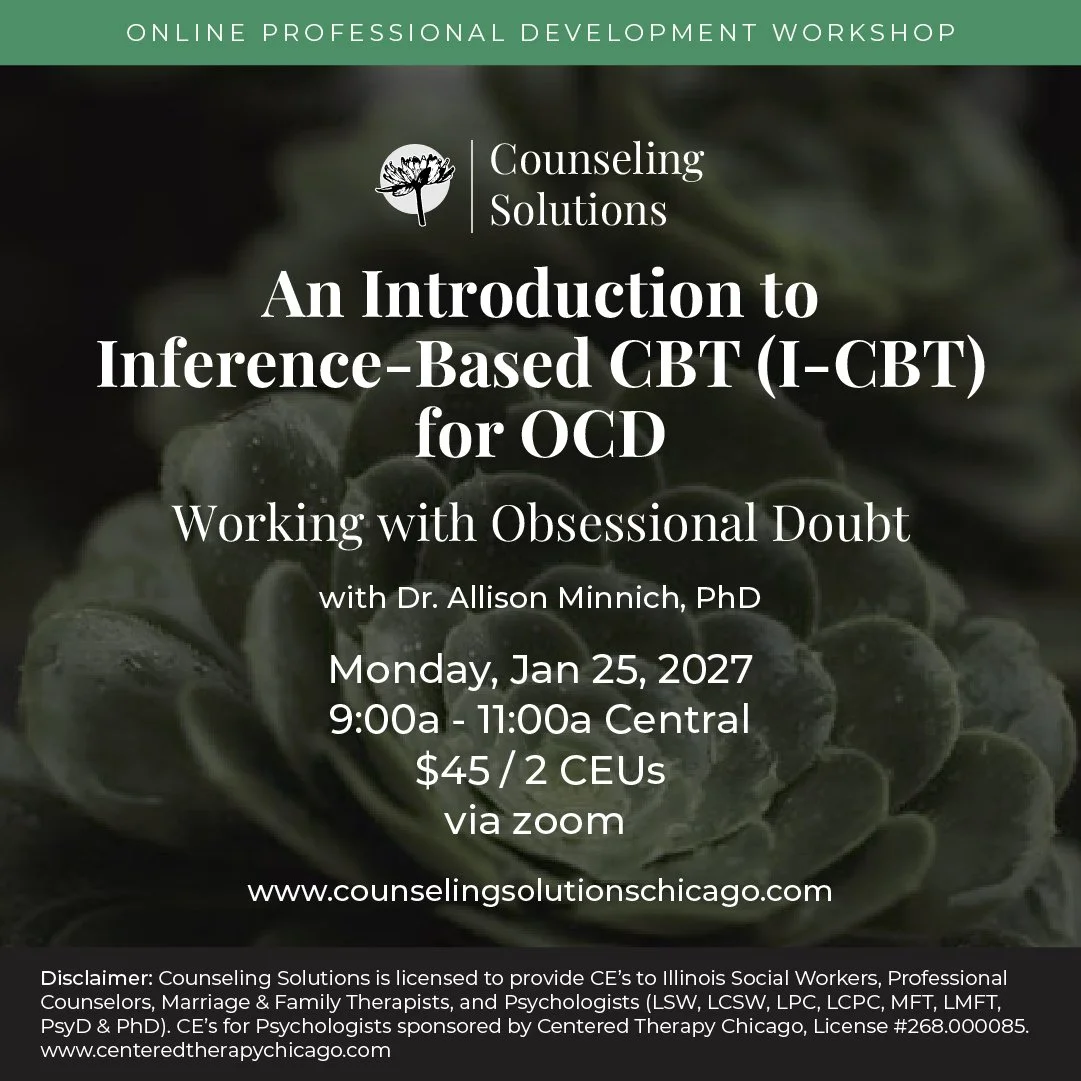
An Introduction to Inference-Based CBT (I-CBT) for OCD
Working with Obsessional Doubt
with Dr. Allison Minnich, PhD
Monday, Jan 25, 2027
9:00 am - 11:00 am Central
$45 / 2 CEU’s
via zoom
Note: Training will be recorded.
Disclaimer: Counseling Solutions is licensed to provide CE’s to Illinois Social Workers, Professional Counselors, Marriage & Family Therapists, and Psychologists (LSW, LCSW, LPC, LCPC, MFT, LMFT, PsyD & PhD).

CE’s for Psychologists sponsored by Centered Therapy Chicago. // License #268.000085

Dr. Allison Minnich, PhD
MEET YOUR FACILITATOR
Dr. Allison Minnich, PhD, is a licensed clinical psychologist and the founder and Clinical Director of the Chicago Center for Behavioral Health, an outpatient practice that specializes in treating OCD and anxiety. Her practice treats OCD with both exposure and response prevention (ERP) and inference-based CBT (I-CBT). She completed I-CBT training in 2022 and has used it with clients since then. Dr. Minnich earned her PhD in Psychological Clinical Science from North Dakota State University. She is a member of the International OCD Foundation and its I-CBT Special Interest Group.
Questions? Email Counseling Solutions here.
